
The Mexican Consumer Your Briefs Are Forgetting
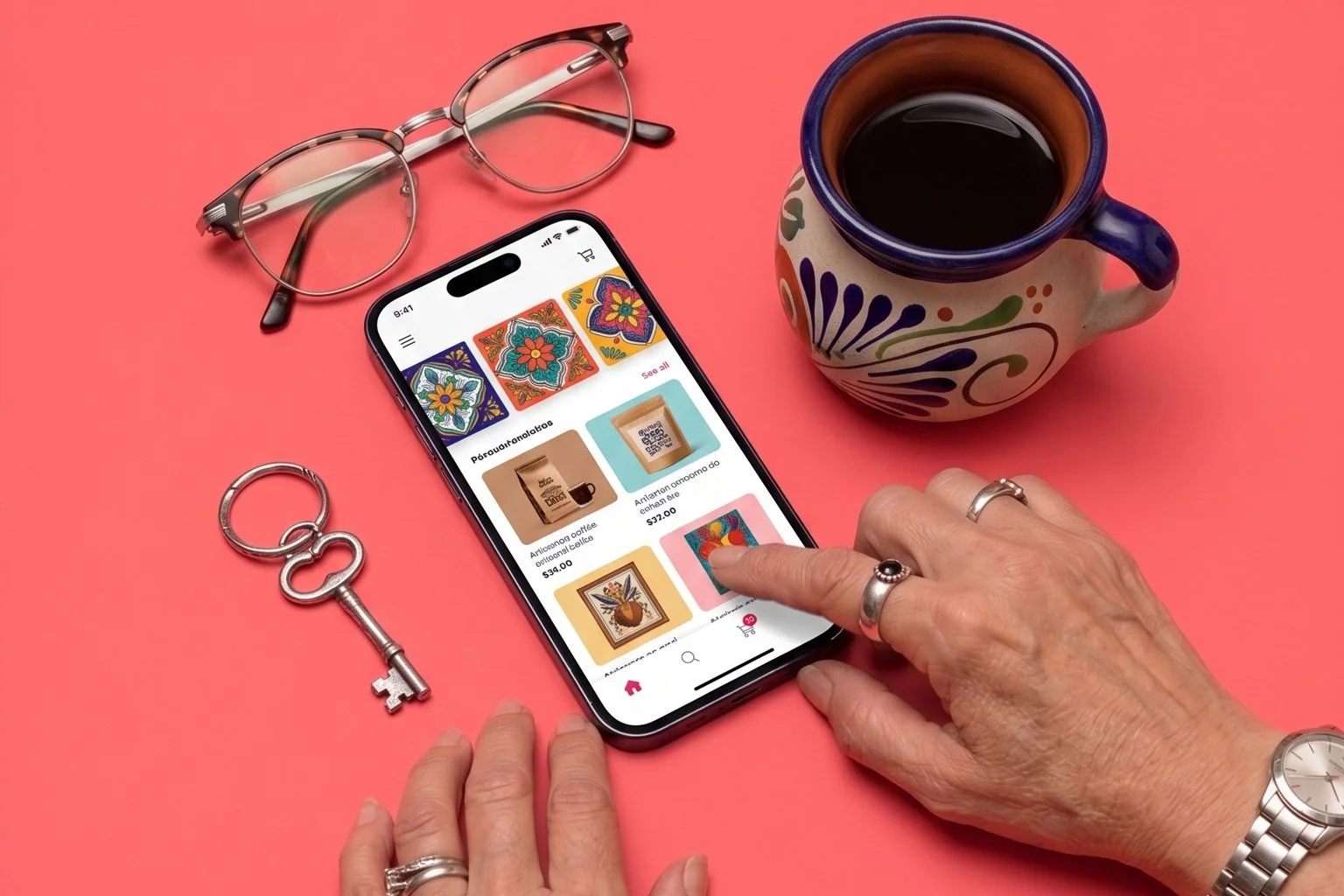
The Vitality of the 60+ demographic
Why age bias in Mexico's marketing is leaving out the segment with the highest loyalty, purchasing power, and buying curiosity
If your brand strategy in Mexico was built by reading global trend reports on the consumer of the future, you've very likely overlooked the segment with the greatest potential for loyalty, growth, and spending in the Mexican market today.
Adults over 60 — a segment CONAPO registers at 17.1 million people in 2024, 12.8% of the total population, reaching 24% of the population by 2050 — are systematically ignored in market research briefs. At Syncretic, 80% of the projects we receive define their study universe between 18 and 45 years old. The 60+ appear, at best, as a footnote.
What sector, demographic, and behavioral data actually show is something different. The silver economy — the set of economic activities oriented toward adults over 50 — represents one of the fastest-growing forces in the global economy. In Mexico, adults over 50 account for 40% of discretionary spending, according to EGADE Business School (Tec de Monterrey). It's not a footnote. It's one of the most underestimated opportunities in the Mexican market.
01 · The Myth of Digital Disconnection
A generation online — on their own terms
The dominant narrative about older Mexican adults and technology is simple: they're a disconnected generation that uses their phone only to talk with their children, and if something needs to be bought online, they ask their grandchildren to do it.
INEGI data tells a more nuanced story.
According to the National Survey on Availability and Use of Information Technologies in Households 2024 (ENDUTIH), 71% of people aged 55 to 64 in Mexico use the internet. In the 65+ group, that figure is 42.1%. Not universal adoption — but not digital invisibility either. These are millions of active users that digital marketing systematically ignores.
Facebook as the segment's dominant platform
Usage patterns matter as much as adoption figures. While adults under 35 migrated to Instagram, TikTok, and Threads, older adults who are online converted Facebook into their central space. Facebook remains the favorite platform among users over 38 in Colombia, Mexico, and Peru, and holds the highest usage rate in Mexico across all social networks, with 92.5% of active users. At Syncretic, we observe that for this segment, Facebook doesn't function as a memory archive — it's an active channel for product discovery, organized community, and health recommendations.
WhatsApp as a recommendation channel — not an advertising channel
There is a social commerce phenomenon that digital behavior studies tend to measure poorly for this segment: peer-to-peer recommendation via WhatsApp. In Mexico, 51.2% of digital buyers use social networks for their purchases, and 28.7% trust recommendations from friends and family more than any other channel — above even influencers (13.4%), according to an EssenceMediacom Latam study from June 2024.
For the older adult, this high-trust recommendation channel concentrates in family and social WhatsApp groups — spaces where the recommender's credibility is personal and accumulated over years. The conversion funnel that digital marketing has spent years trying to optimize exists naturally in these spaces, without brand investment, and with a credibility rate that no paid influencer can replicate.
The sustained attention advantage
A data point that digital behavior studies rarely contextualize: users over 65 spend an average of 3 hours daily on the internet, according to ENDUTIH 2024. Less than younger people in raw time — but with a decisive qualitative difference: they don't infinite-scroll. They read. They compare. They return to content they found useful. For brands investing in quality content, there is an audience here with a sustained attention disposition that no other age segment offers to the same degree.
The implication for brands is direct: the cost of acquiring attention in this segment is low because competition for that space is nearly nonexistent. The question isn't whether this consumer is available — it's whether your brand has something worth saying to them.
02 · The Era of Active Self-Care
From reactive consumer to wellness protagonist
The model that health and wellness marketing used for decades to speak to older adults rested on an implicit assumption: these people consume health products out of necessity. The older adult as reactive consumer — buys what the doctor orders, takes what relieves pain, uses what solves the problem.
Market numbers contradict that model decisively.
The Mexican market for geriatric healthcare products was valued at $13.69 billion in 2024 and is projected at $27.69 billion by 2034, with an annual growth rate of 7.3%, according to Expert Market Research. The functional food market for older adults in Mexico grew to $23.76 million in 2024 and is projected at $42.52 million by 2033. The fastest-growing segment is cognitive health supplements: from $138.6 million in 2024 to a projected $536.8 million by 2033 — an annual rate of 14.5%, according to IMARC Group.
These are not the growth rates of a reactive market. They are the rates of a market pulled by active, growing demand.
Wellness as a life project, not disease management
At Syncretic, we observe this transformation in our qualitative work with mass consumer brands: the contemporary Mexican older adult doesn't seek health as a response to illness — they seek it as a definition of how they want to live this stage of life. Nutritional care, investment in personal aesthetics, sustained attention to ingredients and formulations — these are expressions of an active life project, not a medical condition to manage.
This distinction has direct consequences for brand communication. Brands that speak about their products in terms of treatment or relief are using the wrong register for an audience that perceives itself as the protagonist of its own wellness, not as a patient.
The home as a space for reinvention
In Mexico, where 23% of the population is already over 50 and that proportion will reach 36% by 2050, the implications are direct for high-value categories: home improvement, wellness equipment, technology, and personal care.
At Syncretic, we consistently observe in our qualitative work that older adults in upper-middle-class households are not maintenance buyers — they are active transformation buyers, with available resources and motivation to invest in their quality of life.
The implication for brands is direct: the contemporary Mexican older adult is not the target of the "products for seniors" catalog. They are an active consumer who buys in the same categories as the rest of the family, in a market growing at double-digit rates, and with extraordinarily high loyalty potential when they feel genuinely represented.
03 · The Condescension Trap
Why marketing aimed at over-60s fails systematically
Marketing that exists for older adults in Mexico systematically makes the same mistake: speaking to them from pity, from condescension, or simply from invisibility.
Invisibility is the most widespread and most costly form. The older adult simply doesn't appear in campaigns from brands that, in practice, have 60- and 70-year-olds among their best customers. Telecommunications, banking, mass consumer retail, insurance — all have customer bases with high concentration in this segment — and almost none are speaking to them directly and appropriately.
The gap between self-perception and representation
A CivicScience study found that consumers aged 55 and older are increasingly prioritizing representation, brand values, and quality as conditions for loyalty — above price or convenience. At Syncretic, we observe an equivalent pattern in Mexico: this segment doesn't want to be represented as elderly people who need help. They want to see themselves reflected as what they are: active people, with projects, with formed consumer judgment, and with decades of experience evaluating brand promises.
The gap between this segment's self-perception and the representation it receives in brand communication is enormous — and has direct costs on the effectiveness of that communication.
The patronizing tone trap
When brands do try to address this segment, they frequently make the opposite mistake: an excessively simplified tone, with large fonts, step-by-step instructions, and a forced warmth that 65-year-old consumers perceive as condescending. The intellectual and experiential authority accumulated over decades is real — and communication that doesn't recognize it produces immediate rejection.
Not a visible or vocal rejection: a silent rejection, expressed in the channel change, in the private negative recommendation, in the brand that simply stops being purchased without drama. It's the type of churn that marketing digital dashboards don't register until it's too late.
The implication for brands is direct: the Mexican older adult doesn't want the world simplified for them — they want to be spoken to with respect and represented as they actually are: active, with projects, with decision-making power. The brands that achieve this are building the most durable relationship the Mexican market offers.
04 · The Power of Active Loyalty
The most underestimated brand asset in Mexico
If Gen Z is the generation of deliberate veto — the systematic abandonment of brands they detect as incongruent with their values — the 60+ adult is the generation of active loyalty: the sustained, vocal, and socially transmissible adoption of brands that merit trust.
Academic research confirms this pattern consistently. Older consumers show greater brand loyalty, greater emotional attachment, and greater willingness to pay a premium price for trusted brands, according to studies published in the Journal of Retailing and Consumer Services and the EuroMed Journal of Business. Word-of-mouth outperforms brand image and even satisfaction as a predictor of growth and profitability in this segment.
This loyalty is neither passive nor blind. It is earned loyalty — maintained as long as the brand keeps its promise — and when it is lost, it is lost in ways that standard marketing metrics models are not measuring correctly.
This loyalty operates in ways that standard metrics models don't capture well. Recommending a brand within this segment's family or social network is not sharing a link — it's lending credibility accumulated over decades. And when a brand fails them, the negative recommendation operates with the same intensity but in private: no public posts or reviews, just direct conversation with people they know.
The threshold for entry is high. This segment has decades of experience watching promises broken — coherence between what a brand promises and what it delivers is not a differentiator: it's the price of entry to the relationship. And service is the most decisive loyalty lever: a single condescending interaction can undo months of brand building. The inverse is also true: a genuinely respectful interaction generates active recommendation and long-term loyalty.
The real cost of ignoring them
The geriatric market in Mexico will grow to more than double by 2034. Adults over 50 account for 40% of discretionary spending in Mexico (EGADE Business School).
Brands that ignore this segment are not saving resources — they are ceding them to competitors who arrive first to build that loyalty.
The implication for brands is direct: the cost of acquiring this consumer is low when they are treated with respect, and the lifetime value — measured not only in their own purchases but in the network value they generate in their family and social circle — is substantially higher than current models calculate.
What This Means for Your Brand Strategy in Mexico
The Mexican market has more than 17 million active consumers aged 60 and older, in a segment where adults over 50 account for 40% of discretionary spending (EGADE Business School) and which grows at double-digit rates in the highest-value categories. It is not an ignored niche — it is a structural opportunity that most brands are not claiming.
First: Expand the study universe. The brief that stops at 50 is leaving out the segment with the greatest market growth, highest loyalty potential, and strongest recommendation network.
Second: Speak with respect, not simplification. The contemporary Mexican older adult has decades of consumer experience, formed judgment, and a trained sensitivity for detecting condescension. Brands that treat them as intelligent adults win the conversation. Those that simplify lose it in silence.
Third: Invest in the channels where they are. Facebook and WhatsApp are not secondary channels for this segment — they are their primary ecosystems for discovery and recommendation. A relevant content strategy on these channels has a cost-per-attention efficiency that no other medium can match for this audience right now.
Fourth: Measure the full lifetime value of this consumer. The older adult is not just the sum of their own purchases. Their recommendation network has real reach, with credibility that no paid channel can replicate. The model that ignores this is systematically underestimating the value of this segment.
Is your strategy accounting for the real Mexican consumer aged 60, or a stereotype from the last century?